1. Second
Session: What are human rights and where have they come from
30 January 2023
Welcome to the second session. We will essentially review the Universal Declaration on Human Rights that was agreed in 1948, after a two-year negotiation process. It was the first global definition of human rights. As you will have seen from the readings, there were many predecessors. Based on contributions to the negotiations, there were rights mentioned in many religions, although they were not always called that. The evolution of rights had many sources, starting realistically in the 17th Century, carrying through the American and French revolutions and the increasing notion that rights needed to be reflected in international treaties, starting with the First Geneva Convention adopted in 1864, based on the work of Henri Dunant (see Chapter 6 in Heroes of Human Rights). There were other instances, including agreements on dealing with refugees after World War I. The key point, however, was the agreement on the Universal Declaration in 1948.
Chapter 13 in the class textbook, Heroes of Human Rights, describes the process realistically and shows the role of Eleanor Roosevelt, the chair of the Commission on Human Rights, as well as those of three delegates (from France, Lebanon and China) as well as the secretariat in the form of John Humphrey of Canada who was the head of the UN’s Division for Human Rights for 18 years.
The rights can be seen as falling broadly into two categories: civil and political rights (and here, the United States, along with France and Great Britain, had a leadership role) and economic, social and cultural rights. The latter were pushed, after World War II, by the Soviet Union and its allies.
There was an issue about whether rights accorded to individuals or to society, and who gave them. The consensus in the end was that rights were individual, but had to be seen in a societal context and that States were responsible for ensuring their enjoyment.
The main reason for having rights was found in the United Nations Charter, which agreed on the proposition that global order required that all people on the planet needed to have and enjoy rights. If not, there would be conflict.
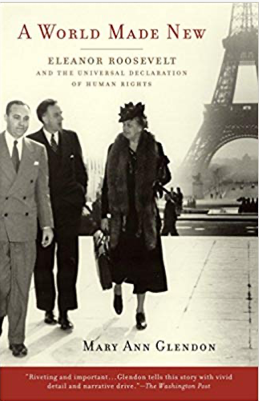
The negotiation of the Universal Declaration is well-represented in a book by Mary Ann Glendon, the Learned Hand Professor at the Harvard Law School. She was also the Holy See’s head of delegation to the Beijing Conference (about which she has written), and also the US Ambassador to the Holy See under George W. Bush, and an advisor to Mike Pompeo as the member of a Commission on Inalienable Rights that seeks to determine what role human rights have in US foreign policy. You can listen to her Lawfare podcast that was done in August 2019 that describes her approach to this. We can discuss this in class.
The current Biden Administration has returned the United States to its more traditional position that, as we will see next week, is not as pro-human rights as it sometimes asserts.